
Skip to content
  • Jump to:
  • Damage symptoms
  • Life cycle
  • Management

What is powdery mildew of tomato?

Powdery mildew of tomato is a highly contagious foliar disease caused by the fungus Oidium neolycopersici. The pathogen can quickly limit yield potential if left unmanaged, affecting both protected greenhouse and open-field tomato production globally.

The pathogen Oidium neolycopersici thrives in warm, high-humidity conditions, allowing infections to spread rapidly. The disease severely reduces photosynthetic capacity, leading to premature defoliation, stunted plant development, and a sharp drop in both marketable yield and fruit quality.

Early detection is critical, and effective management is essential to prevent crop losses and maintain healthy tomato plants.

  Biological solutions for Powdery mildew of tomato  

Filters:
Clear all filters
Show all Show less
products found:

Questions or need help?

Contact us

Learn more about

Powdery mildew of tomato damage symptoms
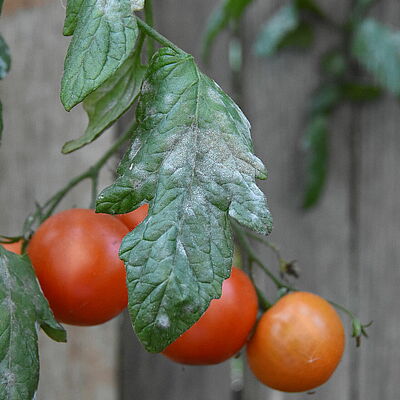
Leaf symptoms

  • Small, circular, bright white powdery patches appear initially on the upper leaf surface
  • Spores coalesce into larger powdery patches covering large portions of the leaf
  • Chlorosis (yellowing) surrounding infected areas
  • Leaf necrosis under severe infections
  • Premature leaf drop and senescence (browning and death)

Stem and petiole symptoms

  • White epiphytic growth moves beyond the leaves to colonize petioles and main stems
  • Extensive epiphytic growth on stems and petioles can reduce vigor and increase susceptibility to secondary stress

Indirect damage symptoms

  • Severe defoliation alters the microclimate of the crop, the photosynthetic capacity, and stalls overall plant development.
  • The loss of protective foliage exposes developing tomato clusters directly to intense solar radiation, resulting in sunscald, poor color uniformity, and unmarketable fruit.
  • Fruit may ripen prematurely, yielding smaller fruit and a diminished flavor profile.

Do not confuse this with Leveillula taurica (Internal powdery mildew). Oidium produces clear white powder on the upper leaf surface. Leveillula lives inside the leaf keeping its white powdery sporulation strictly hidden on the underside of the leaf.

Life cycle of powdery mildew of tomato

Survival

Oidium neolycopersici relies on active mycelium to survive between cropping cycles in greenhouse tomato plants or alternative hosts outdoor.

Infection and colonization

Airborne conidia are transported by wind to healthy leaves. Under favorable conditions, spores land, germinate on the leaf surface and penetrates epidermal cells. It then develops specialized feeding structures called haustoria inside the epidermal cells to extract nutrients without immediately killing the host cell.

Reproduction and dispersal

Within 5-7 days in optimal conditions, the superficial fungal network matures, producing upright conidiophores that release new spores continuously on infected tissue. These conidia are dispersed by air currents throughout the crop. Because the pathogen has a short generation time, multiple infection cycles can occur during a single growing season, allowing disease levels to increase rapidly.

Powdery mildew development is favored by:

  • Temperatures between 20°C and 27°C
  • Moderate to high relative humidity
  • Dense, poorly ventilated air within dense greenhouse or field canopies

Free moisture on leaves (heavy rain or overhead irrigation) can reduce spore survival.

How to manage powdery mildew of tomato

An integrated disease management strategy is essential for effective control of powdery mildew in tomato crops.

Cultural practices

  • Use resistant varieties: Where available, incorporate tomato varieties with resistance or tolerance to powdery mildew. Resistant varieties can significantly reduce disease severity and dependence on curative treatments.
  • Remove sources of infection: Eliminate weeds and volunteers near the production field or greenhouse structure. Remove crop residues that may serve as reservoirs for the pathogen. Good crop hygiene reduces the risk of early-season infections.
  • Optimize crop conditions: Reduce high-humidity microclimates within the canopy. Ensure proper row spacing and implement routine pruning of lower suckers and older leaves to reduce canopy density and minimize low-light, high-humidity zones.
  • Support plant resilience: Maintain balanced fertilization and proper irrigation to sustain vigor and tolerance under disease pressure.

Monitoring

  • Monitor crops regularly: Inspect crops at least twice a week, focusing on the interior canopy and lower, older leaves, especially during periods of favorable environmental conditions. Early detection allows timely intervention before the disease becomes widespread.

Biological control

  • Combining cultural practices, regular monitoring, preventive and timely interventions, biological control solutions, and other Integrated Pest Management (IPM) practices limits disease development, prevent severe outbreaks, and protect crop productivity.
  • Apply preventive biocontrol agents early in low-pressure windows to suppress spore establishment. Early action is particularly important because once extensive fungal growth has developed, restoring canopy health becomes increasingly difficult.
Need help?