Skip to content
  • Jump to:
  • Damage
  • Life cycle
  • Management

What is internal powdery mildew (Leveillula Taurica)?

Internal powdery mildew, caused by the obligate fungal pathogen Leveillula taurica affects a wide host range. While it heavily impacts crops such as tomato, pepper, and eggplant, it can also target onion, garlic, cotton, and various ornamental species.

Unlike typical powdery mildew fungi (Erisiphe or Podosphaera species), that grow epiphytically, Leveillula taurica exhibits a hemi-endophytic lifecycle: It enters the host exclusively through stomata (natural leaf openings) and colonizes the internal intercellular space of the leaf tissue before emerging to produce visible spores on the surface. Because the mycelium grows entirely inside the leaf before emerging to produce spores on the leaf surface, extensive internal damage occurs long before any visible symptoms on the surface.

This cryptic infection cycle makes early detection challenging but critical.

  • Easy to use
  • Minimal resistance
  • No chemical residues
  • No pre-harvest intervals

Learn more about

Internal powdery mildew damage symptoms  

Leveillula taurica is an internal pathogen. This is why symptoms follow a distinct spatial progression on the plant.

Leaf symptoms

  • Upper leaf surface:
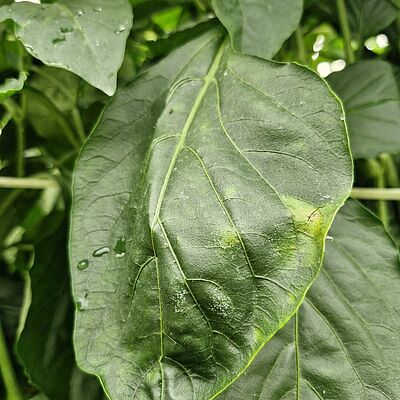
    • Bright yellow, irregular, or angular chlorotic lesions forming between leaf veins, developing first on older leaves. As the disease progresses, these lesions turn necrotic (brown) from the center outward.
    • Progressive yellowing of infected leave
  • Fungal:
    • A faint, sparse, white to gray powdery growth appears directly beneath the upper yellow lesions, where fungal structures exit through the stomata. Easily overlooked, especially before extensive internal colonization
    • Severely infected leaves curl upward, dry out, and drop prematurely
    • Premature leaf senescence
    • Development of necrotic lesions in severely affected tissue

Indirect damage

  • Reduced photosynthetic capacity and canopy density
  • Decreased plant growth and development
  • Increased susceptibility to sunscalds and abiotic stress following severe defoliation
  • Reduced fruit, bulb, or harvest quality depending on the host crop

Severe infections can result in extensive leaf loss and significant reductions in crop productivity.

Life cycle of internal powdery mildew  

Survival

Leveillula taurica survives between cropping cycles as active mycelium on living host plants, volunteer crops, crop residues, and numerous cultivated and wild plant species. Its broad host range support year-round persistence and frequent reintroduction of inoculum into production fields and greenhouses.

Infection and colonization

The epidemic starts when airborne conidia land on a susceptible plant tissue. Unlike most powdery mildew pathogens, this species has a hemi-endophytic lifecycle: infection is typically initiated when fungal growth establishes in leaf tissue (often after stomatal entry), and external sporulation develops later as a visible white mycelian coating, commonly appearing on the underside of leaves beneath chlorotic spots. As the fungus colonizes the host, it spreads within leaf tissue and extracts nutrients, leading to chlorosis and necrosis.

Reproduction and dispersal

Within 5-7 days under optimal conditions, conidiophores and conidiaemerge through the stomata on the underside of leaves. These spores are then dispersed by wind and air currents to neighboring plants, initiating secondary infections. Multiple disease cycles can occur during a single growing season, allowing the pathogen to spread rapidly under favorable conditions.

Powdery mildew development is favored by:

  • Temperatures between 25°C and 35°C
  • Moderate to high relative humidity
  • Dense, poorly ventilated canopy
  • Unlike many foliar pathogens, free moisture on leaf surfaces is not required for infection and may inhibit spore production and dispersal.

How to manage internal powdery mildew  

An integrated disease management strategy is essential for effective control of internal powdery mildew caused by Leveillula taurica.

Cultural practices

  • Use resistant varieties: Where available, select crop varieties with resistance or tolerance to powdery mildew. Resistant cultivars can help reduce disease severity and slow epidemic development.
  • Remove sources of infection: Remove infected residues, volunteer plants, and alternative host plants where practical. Good sanitation practices help reduce inoculum sources between cropping cycles.
  • Optimize crop conditions: Reduce canopy humidity and improve airflow with appropriate spacing, pruning, and climate management to disrupt disease development.

Monitoring

  • Monitor crops regularly: Inspect chlorotic leaf spots on the upper leaf surface and check the leaf underside for characteristic white mycelial coating, since symptoms can precede obvious, heavy sporulation.
  • Support plant resilience: Maintain balanced fertilization and proper irrigation to sustain vigor and tolerance under disease pressure.

Biological control

  • Apply an integrated control strategy

Combining cultural practices, regular monitoring, preventive and timely interventions, biological control solutions, and other Integrated Pest Management (IPM) practices limits disease development, prevent severe outbreaks, and protect crop productivity.

Early preventative control measures are important before visible symptoms appear, particularly under warm, humid conditions.

Need help?