
Skip to content
  • Jump to:
  • Damage
  • Life cycle
  • Management

What is Flavescence dorée?

Flavescence dorée is a devastating grapevine disease caused by the phytoplasma 'Candidatus Phytoplasma vitis'. The pathogen disrupts the vine's vascular system, impairing the transport of sugar and nutrients, which leads to reduced productivity, severe physiological decline, and eventually death of the vine.

The primary vector of Flavescence dorée is the leafhopper Scaphoideus titanus, which acquires the phytoplasma while feeding on infected vines and subsequently spreads it to healthy grapevines. The rapid proliferation and dispersal of Scaphoideus titanus within vineyards facilitate the spread of the disease, making containment challenging.

Flavescence dorée is among the most serious grapevine diseases in Europe, causing significant yield and quality losses. Because no curative treatment exists, infected vines must be removed to prevent the disease from spreading to healthy plants.

  Biological solutions for Flavescence dorée  

Filters:
Clear all filters
Show all Show less
products found:

Questions or need help?

Contact us
  • Easy to use
  • Minimal resistance
  • No chemical residues
  • No pre-harvest intervals

Learn more about

Flavescence dorée damage symptoms
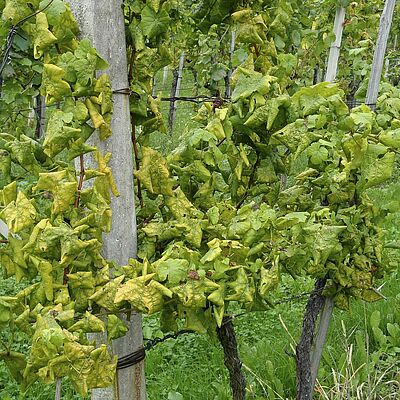
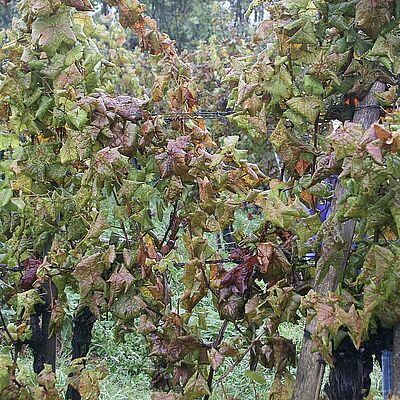
Symptoms of Flavescence dorée typically appear during summer and may affect individual shoots or entire vines.

Leaf symptoms

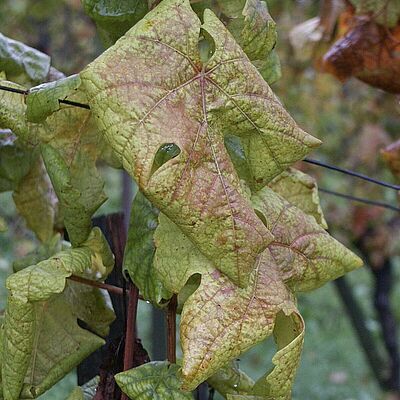
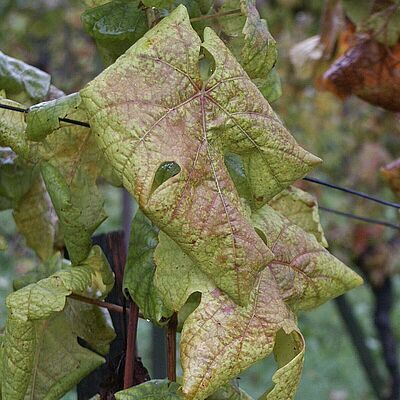
Discoloration:

  • Yellowing in white grape varieties
  • Reddening in red grape varieties

Morphological changes:

  • Downward rolling of leaf margins
  • Thickened and brittle leaves

Shoot symptoms

Growth abnormalities:

  • Poor lignification
  • Shoots remaining green and flexible late in the season

Physiological stress:

  • Wilting of young shoots
  • Cluster symptoms

Reproductive failure:

  • Flower abortion
  • Poor fruit set

Fruit deterioration:

  • Shriveling of grape clusters
  • Premature drying of berries

Molecular testing (PCR analysis) is required to distinguish Flavescence dorée from Bois noir symptoms.

Life cycle of Flavescence dorée

Causal agent

Flavescence dorée is caused by a phytoplasma Candidatus Phytoplasma vitis, which persists in both infected grapevines and its insect vector, Scaphoideus titanus.

Acquisition & transmission

The leafhopper Scaphoideus titanus can acquire the phytoplasma starting from its earlier nymphal stages while feeding on infected grapevines. After a long latent period within the insect, the phytoplasma can be transmitted to healthy vines during subsequent feeding. Once infected, vines remain a permanent source of inoculum for further spread within the vineyard.

Due to the pathogen's long latent period inside the vector, only older nymphs and adults can transmit the phytoplasma. This highlights the importance of preventive treatments, specifically targeting young nymphal instars before they become infectious.

Disease development

Symptoms may not become visible until months after the initial infection. Since infected vines act as persistent reservoirs for the pathogen, early detection and removal are critical to prevent further epidemic spread within the vineyard.

Management of Flavescence dorée

Since there is no curative treatment for Flavescence dorée once vines are infected, strict prevention is essential for disease management. Effective strategies focus on reducing vector populations and eliminating pathogen reservoirs.

IPM measures

  • Cultural practices
  • Certified planting material: Use only disease-free (certified) propagation material to prevent introductions
  • Infected vine removal: Remove and destroy infected vines to eliminate inoculum sources

Monitoring

  • Vector monitoring: Monitor leafhopper populations throughout the growing season via sticky traps or canopy counts to guide interventions
  • Vineyards monitoring: Monitor vineyards systematically throughout the season for early visual symptoms

Control of Flavescence dorée

Lumiere is an emulsion concentrate based on paraffinic oil. It can be used as part of an Integrated Pest Management strategy to help control Scaphoideus titanus, the vector responsible for spreading Flavescence dorée. Lumiere works through physical contact, helping reduce vector populations and thereby lowering the risk of disease transmission in the vineyard. Lumiere shows high efficacy particularly on young larval instars, therefore we recommend applying as early as possible upon young larvae detection. This recommendation is backed up by the fact that young larvae are not able to transmit the disease. Controlling the larvae of Scaphoideus titanus will stop the disease transmission of Flavescence dorée.

Need help?