
Skip to content
  • Jump to:
  • Identification
  • Life cycle
  • Damage
  • Monitoring and detection
  • Biocontrol

Why is Scaphoideus titanus a critical threat to viticulture?

Scaphoideus titanus is a leafhopper species that has become a primary threat to Mediterranean vineyards since its first introduction in the mid-20th century from North America. While its direct feeding damage is minimal, it is the principal vector of Flavescence dorée, a quarantine phytoplasma disease that can devastate entire vineyard regions.

The economic impact of Flavescence dorée

  • Epidemic potential: Its persistent circulative transmission cycle allows the disease to spread rapidly once it is established.
  • Regulatory restrictions: Many European regions mandate compulsory chemical treatments, increasing operational costs and environmental pressure.
  • Yield loss: Infection leads to stunted growth and total berry shriveling, often requiring the uprooting of infected vines.

Once the disease is established, vineyard recovery is difficult and costly, making prevention and early control essential.

Biological solutions for Scaphoideus titanus

Filters:
Clear all filters
Show all Show less
products found:

Questions or need help?

Contact us
  • Easy to use
  • Minimal resistance
  • No chemical residues
  • No pre-harvest intervals

Learn more about

Identification of Scaphoideus titanus

Accurate identification is essential to distinguish Scaphoideus titanus from non-vector leafhoppers that may co-exist in the vineyard.

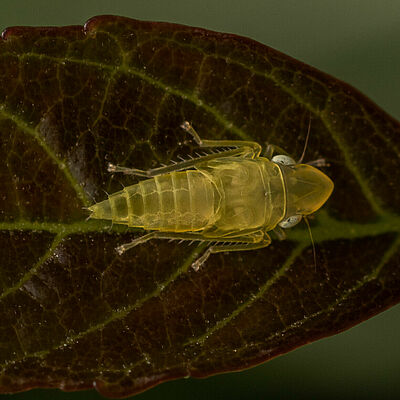
Nymph characteristics (primary control target)

  • Appearance: Whitish in early stages (N1-N3), developing ochre or brown spots in later instars (N4-N5).
  • Marker: All nymphal stages possess two distinct black spots on the last abdominal segment.
  • Behavior: Highly mobile, jump when disturbed and typically found on the underside of basal leaves.

Adult characteristics:

  • Size: 56 mm long.
  • Color: Brownish-ochre with white and dark markings on the wings and characteristic red-brown transverse bands on the head and thorax.
  • Wings: Fully developed, held roof-like over the body.

Not be confused with:

Several other leafhoppers can be present in European grapevines: Empoasca vitis, Erasmoneura vulnerata and Jacobyasca lybica. They have several life cycles per year and show different behaviour and damage. For instance, Empoasca vitis has a greener colour, and crabwalk when disturbed.

Life cycle of Scaphoideus titanus

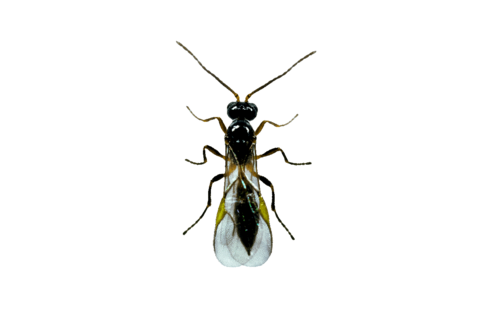
Scaphoideus titanus is univoltine (one generation per year), which simplifies timing for biocontrol interventions. Understanding the life cycle of Scaphoideus titanus helps optimize control strategies.

  • Egg stage (winter): Overwinter as eggs under the bark of two-year-old wood.
  • Nymph emergence (May - June): Emerge in spring. Nymphs undergo five instars (N1 to N5) over 21–53 days.
  • Adult activity (July - October): Adults appear in late June or July.
  • Oviposition (August - October): Females begin laying eggs 12–14 days after emergence, with activity continuing into late autumn.

Damage and disease transmission by Scaphoideus titanus

Understanding the latent period is critical for biocontrol timing.

  1. Acquisition: Nymphs acquire the phytoplasma by feeding on the phloem of infected vines.
  2. Incubation: The phytoplasma multiplies within the insect (persistent – propagative) before it can be transmitted.
  3. Infectious phase: Only nymphs from the 4th instar (N4) onwards and adults are typically capable of spreading the disease.

Note: Targeting N1-N3 nymphs prevents them from ever reaching the infectious stage.

Direct damage:

  • Limited impact from feeding
  • Minor leaf discoloration

Indirect damage (critical):

  • Spread of Flavescence dorée, causing:
    • Yellowing or reddening of leaves (depending on grapevine bunches colours)
    • Leaf curling
    • Poor lignification of shoots
    • Shriveling of grapes
    • Vine decline and death

Monitoring and detection

Early detection is key to preventing outbreaks. Effective management requires a multi-monitoring approach.

Recommended monitoring methods:

  • Visual scouting: Inspect the undersides of leaves starting in late May to detect early-stage nymphs (N1-N3).
  • Yellow sticky traps: Monitor adult activity and migration from neighboring vineyards.

Monitoring should be integrated into a broader Integrated Pest Management (IPM) strategy.

Biological control of Scaphoideus titanus

Sustainable vineyard management requires biological solutions that reduce reliance on chemical insecticides while maintaining control effectiveness.

Key principles:

  • Target nymph stages, which are more vulnerable
  • Combine biological solutions with monitoring and cultural practices
  • Support natural enemies and biodiversity

Targeted bio-insecticide solutions:

  • Lumiere: A physical-action bio-insecticide provides an immediate curative effect by forming a physical film over the insect. Mode of action: Mechanical suffocation and disruption of the cuticle.
  • Mycotal: new Biocontrol larvicide solutions, based on the entomopathogenic fungus Akanthomyces muscarius Ve6 - under registration process in Europe…
  • Casea: based on Beneficial nematodes, under development.

By integrating these biological alternatives into your strategy, growers can:

  • Reduce leafhopper populations early in the season
  • Lower the risk of Flavescence dorée transmission
  • Minimize reliance on conventional insecticides
Need help?