Skip to content
  • Jump to:
  • Damage symptoms
  • Life cycle
  • Management

What is powdery mildew of strawberry?

Powdery mildew of strawberry is a fungal disease caused by Podosphaera aphanis. It is one of the most important diseases affecting strawberry production worldwide and can occur in open-field, tunnel, and greenhouse cultivation systems.

The pathogen infects leaves, flowers, fruit, and flower stalks. Under favorable conditions, powdery mildew of strawberry can spread rapidly throughout a crop, reducing plant vigor, fruit quality, and marketable yield. Many commercial strawberry cultivars are susceptible, making early detection and preventive disease management essential.

The disease develops optimally at moderate temperatures, high humidity enabling spring and fall infections in temperate strawberry production regions.

  Biological solutions for Powdery mildew of strawberry  

Filters:
Clear all filters
Show all Show less
products found:

Questions or need help?

Contact us
  • Easy to use
  • Minimal resistance
  • No chemical residues
  • No pre-harvest intervals

Learn more about

Powdery mildew of strawberry damage symptoms
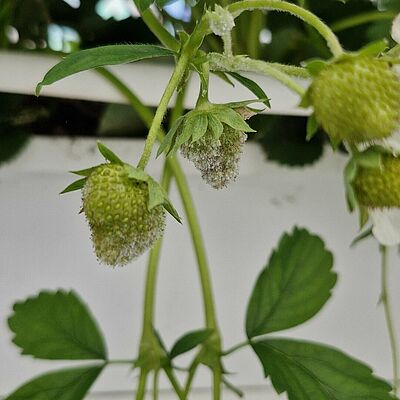
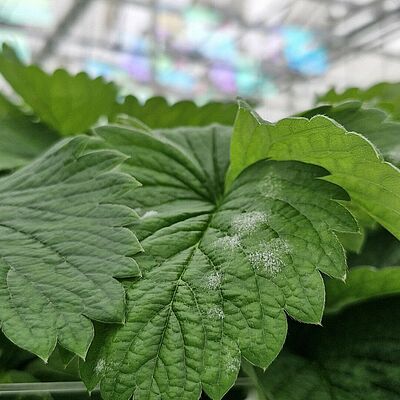
Symptoms of powdery mildew of strawberry can develop on leaves, flowers, and fruit and may occur throughout the growing season.

Leaf symptoms

  • Upward curling of leaf margins, exposing the lower leaf surface
  • White to grayish-white fungal colonies form on the underside of leaves
  • Powdery white fungal colonies expanding across infected tissue on both surfaces
  • Severe purple to red blotches on the upper leaf surface with a halo appearance
  • Progressive discoloration as disease severity increases
  • Premature leaf senescence
  • Necrosis of severely infected tissue

Flower symptoms

  • Fine white mycelial growth on the petals, sepals, and flower stalks (pedicels)
  • Reduced flower development, poor pollination and fruit set
  • Flower abortion under severe disease pressure

Fruit symptoms

  • White powdery dusting on green and ripening berries
  • Fruit deformation and uneven ripening
  • Severe seed bronzing (seeds look brown and dry), making the fruit unmarketable
  • Infection during flowering and early fruit development poses the highest yield threat, as these periods are critical for fruit set and early marketability. Late-season infections primarily affect fruit quality and shelf life rather than fruit set

Life cycle of powdery mildew of strawberry

Survival

Podosphaera aphanis survives between cropping cycles on infected strawberry leaves or latent, asymptomatic infections deep within the crown tissue of transplants. While sexual chasmothecia form on dead leaves and release overwintered ascospores, clean stock contamination via hidden crown infections is the primary source of infections.

Infection and colonization

The disease cycle begins when airborne spores land on susceptible plant tissue. The fungus germinates on the plant surface as a biotrophic pathogen, developing haustoria to extract nutrients from epidermal cells. It infects leaves, flowers, and fruit.

Reproduction and dispersal

Within 7-10 days under optimal conditions, it develops superficial fungal growth and produces new spores that are dispersed by wind and air movement. Multiple infection cycles can occur during a single growing season, allowing disease levels to increase rapidly under favorable conditions.

Powdery mildew development is favored by:

  • Temperatures between 15°C and 27°C
  • High relative humidity
  • Dense crop canopies with poor air circulation
  • Protected cultivation systems
  • Susceptible strawberry varieties

Unlike many foliar pathogens, free moisture is not required for infection and prolonged leaf wetness may inhibit disease development.

How to manage powdery mildew of strawberry

An integrated disease management strategy is essential for effective control of powdery mildew in strawberry crops.

Cultural practices

  • Use resistant varieties: Select strawberry cultivars with resistance or tolerance to powdery mildew; resistant cultivars can help reduce disease pressure and improve crop performance.
  • Ensure disease-free transplants: Source transplants from certified nurseries and with rigorous sanitation protocols. Because crown infections can remain asymptomatic during vegetative runners phase, testing and proactive inspection of stock is essential.
  • Remove sources of infection: In perennial plantings and year-round protected systems, remove infected leaves and runners regularly throughout the season, not just between cycles, to maintain inoculum control.
  • Optimize crop conditions: Promote good air circulation through appropriate plant spacing, canopy management, and climate control. Reducing humidity within the crop can help limit disease development.
  • Support plant resilience: Maintain balanced fertilization and proper irrigation to sustain vigor and tolerance under disease pressure.

Monitoring

  • Monitor crops regularly: Inspect crops twice weekly stating in early spring for leaf curling, red or purple discoloration, and white powdery growth on the underside of leaves. Early detection helps prevent disease spread to flowers and fruit.

Biological control

Combining cultural practices, regular monitoring, preventive and timely interventions, biological control solutions, and other Integrated Pest Management (IPM) practices limits disease development, prevent severe outbreaks, and protect crop productivity.

Early intervention is particularly important because infections of flowers and fruit can directly affect marketable yield and profitability.

Need help?