Skip to content
  • Jump to:
  • Damage symptoms
  • Life cycle
  • Management

What is powdery mildew of cucurbits?

Powdery mildew of cucurbits (Podosphaera xanthii) is one of the most widespread and economically destructive foliar diseases affecting cucurbit crops worldwide. It poses a constant threat to all major cultivated cucurbits, including cucumber, melon, watermelon, squash, pumpkin, and zucchini.

The disease is predominantly caused by the (obligate biotrophic) fungus Podosphaera xanthii. Unlike many fungal pathogens, Podosphaera xanthii conidia (asexual spores) do not require free water on leaf surfaces to germinate; in fact, prolonged leaf witness can inhibit them. Instead, they thrive in warm, dry daytime environments paired with high relative humidity at nights. By aggressively extracting nutrients from living plant tissues, powdery mildew rapidly compromises plant vigor, leading to poor fruit quality. Early detection and effective disease management are essential to minimize economic losses and maintain healthy crops.

  Biological solutions for Powdery mildew of cucurbits  

Filters:
Clear all filters
Show all Show less
products found:

Questions or need help?

Contact us

Learn more about

Powdery mildew of cucurbits damage symptoms 
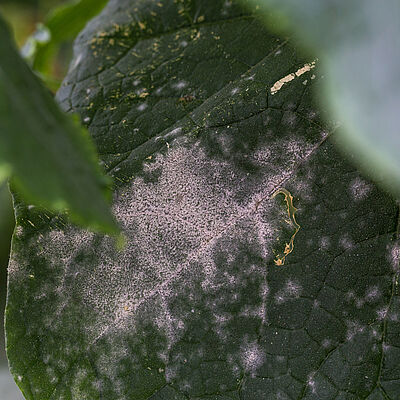
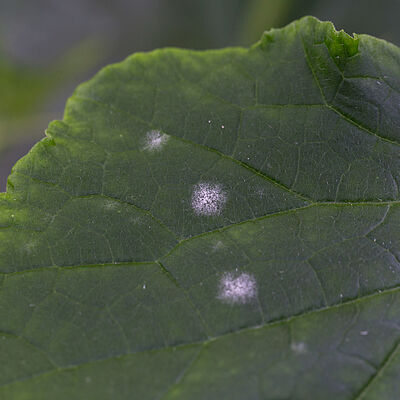
Symptoms of powdery mildew of cucurbits typically manifest first on older leaves, lower leaves, especially those in shaded, high-humidity microclimates within the canopy.

Leaf symptoms

  • Small, circular, powder-like white spots initially on the underside, rapidly spreading to the upper leaf surface.
  • Spots coalesce into large, dusty white patches covering large portions of the leaf
  • Chlorosis (yellowing) surrounding infected areas
  • Leaf necrosis (tissue death) under severe infections
  • Premature leaf drop and senescence

Stem and petiole symptoms

  • Fine white fungal dusting progresses from the leaves to the petioles and stems
  • Thick white fungal growth on stems and petioles that reduce vigor and increase susceptibility to secondary stress.

Indirect damage symptoms

  • Reduced photosynthetic capacity and overall plant and canopy development.
  • Premature defoliation strips away the protective leaf canopy, exposing fruit to intense sunlight, which causes severe sunscalds, particularly on light colored or thin-skinned varieties.
  • Fruit may ripen prematurely, showing poor flavor, lower sugar levels, and incomplete development.

Life cycle of powdery mildew of cucurbits

Survival

Podosphaera xanthii survives between cropping cycles as active mycelium on volunteer cucurbits and alternative host plants. It can also form chasmothecia (also called cleistothecia; sexual resting structures) in regions with prolonged cold winters.

Infection and colonization

Airborne conidia are carried by wind currents onto susceptible healthy tissue. Spores germinate externally (epiphytic growth) and send haustoria (a specialized feeding structure) into epidermal cells to extract nutrients.

Reproduction and dispersal

Within 7-10 days of the initial infection in optimal conditions, the white patches disperse new spores throughout the crop and surrounding fields, causing secondary infections. This rapid reproductive cycle enables multiple infection cycles during a single growing season, leading to explosive disease development.

Powdery mildew development is favored by:

  • Temperatures between 20°C and 27°C
  • Moderate to high relative humidity
  • Dense crop canopies in shaded areas with poor air circulation

Unlike many foliar diseases, prolonged leaf wetness is not required for infection and may even inhibit spore germination.

How to manage powdery mildew of cucurbits

An integrated disease management strategy is essential for effective control of powdery mildew in cucurbit crops.

Cultural practices

  • Use resistant varieties: Prioritize cultivars with genetic resistance or tolerance to Podosphaera xanthii. Resistance can significantly reduce disease severity and dependence on curative treatments.
  • Remove sources of infection: Eliminate weed hosts or wild cucurbits near field borders. Remove crop residues promptly post-harvest. Good crop hygiene reduces the risk of early-season infections.
  • Optimize crop conditions: Reduce high-humidity microclimates within the canopy. Space rows properly and use pruning to maximize light penetration and air flow.
  • Support plant resilience: Maintain balanced fertilization and proper irrigation to sustain vigor and tolerance under disease pressure.

Monitoring

  • Monitor crops regularly: Inspect crops twice weekly during favorable conditions; weekly during unfavorable periods, paying attention to the older and lower leaves, especially during periods of favorable environmental conditions. Early detection allows timely intervention before the disease becomes widespread.

Biological control

  • Biological control of powdery mildew in cucurbits: Powdery mildew can develop rapidly. Combining cultural practices, regular monitoring, preventive and timely interventions, biological control solutions, and other Integrated Pest Management (IPM) practices limits disease development, prevent severe outbreaks, and protect crop productivity. Early action is particularly important because once extensive fungal growth has developed, restoring canopy health becomes increasingly difficult.
Need help?