
Skip to content

General

Xanthomonas vesicatoria is a bacterium that causes bacterial leaf spot on peppers and tomatoes.

Biological solutions for Bacterial spot

Filters:
Clear all filters
Show all Show less
products found:

Questions or need help?

Find a reseller
  • Easy to use
  • Minimal resistance
  • No chemical residues
  • No pre-harvest intervals

Learn more about

Damage symptoms

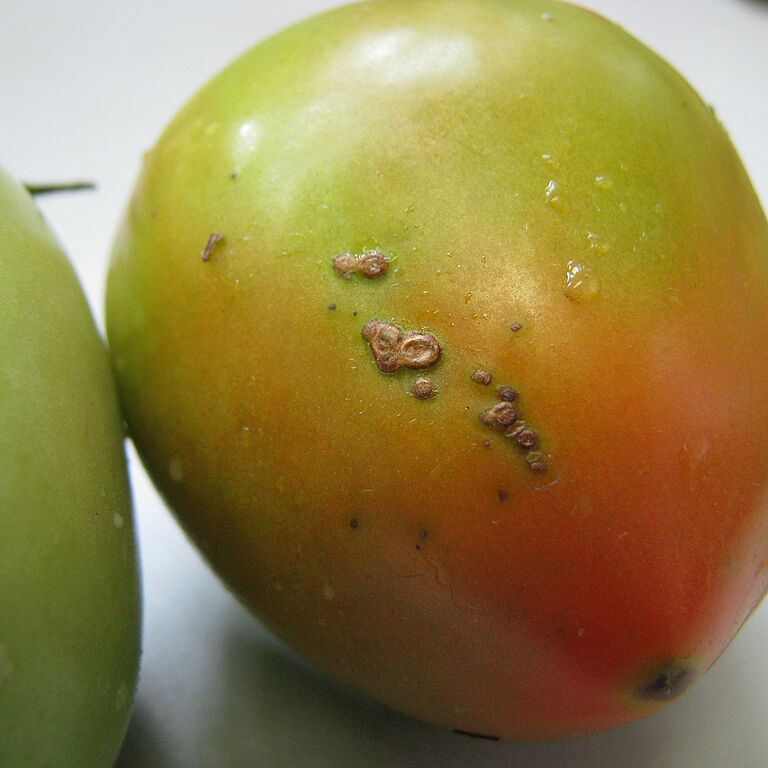
Xanthomonas vesicatoria in tomato causes small, water-soaked spots on leaves which are first round and become more angular as they grow. The centre of the lesions may fall out as they become drier. Under humid conditions, the spots may merge with lesions on the petioles and stems and form long dark streaks. On fruits, first small black specks are seen on green fruits. The specks grow into brown spots that look like scab. These spots may be surrounded by a halo.

In pepper, the spots on the leaves are also round and small to start with and slightly raised from the leaf surface. They occur on the abaxial (underside of) leaf surfaces and may enlarge into dark brown lesions with a light brown centre. As with powdery mildew infection, pepper plants shed the leaves that are severely infected. Humid conditions are conducive for lesion expansion. On the stems, long, narrow cankers appear, which become rough and light brown. On fruits the spots are first small, circular and green but they turn brown, become raised and look like cracked scab.

Life cycle and appearance of Bacterial spot

Xanthomonas vesicatoria survives on volunteer tomato plants in the field and on diseased plant debris. The bacteria are also seed-transmitted. Disease development is favoured by temperatures between 24 and 30 °C and high precipitation due to rain, fog or overhead irrigation. Infection is through stomata and wounds. The dispersal is in windblown water drops, mechanical means such as clipping and handling and aerosols. Many isolates are resistant to copper-containing pesticides.

How to prevent Bacterial spot

  • Use clean propagation material and disease-free seed
  • Remove sources of inoculum such as dead leaves
  • In field-grown tomato and pepper rotate fields to prevent infection from volunteer plants and crop debris
  • Avoid waste piles in the vicinity of the greenhouse or field
  • Resistant cultivars of pepper are available and should be used

Prevent plant diseases by optimizing plant potential and crop resilience.

Need help?