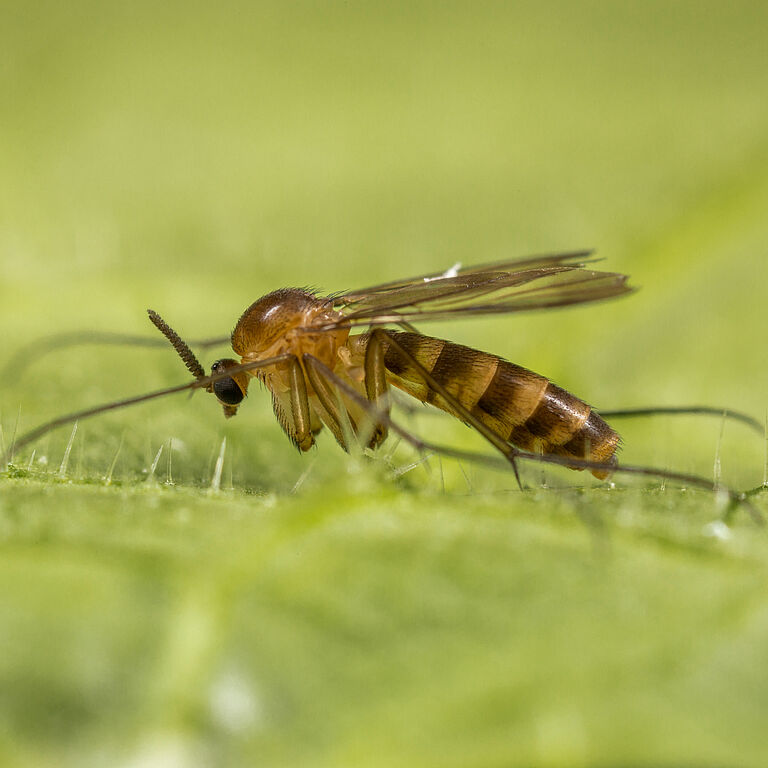
Life cycle and appearance of Lyprauta
The adults of the three species can be distinguished by the wing pattern of adults. Adults of P. trinidadensis have a variation of dark-coloured markings spread over their wings. Adults of L. cambria have a large dark-coloured mark on the apical wing parts as well as two smaller marks. Adults of L. chacoensis have only one small dark-coloured spot on their wings.
The eggs of Lyprauta sp. are greyish-black and spherical. Larvae of Lyprauta sp. are a transparent greyish white and have a long slender body. The head is brown or reddish. The pupae are white to yellow and embedded in a dense web.
Adult flies are long and slender and have a dark brown head with short antennae. The thorax is brownish-yellow and the abdomen brown with yellow stripes. The wings are transparent light brown with clearly visible veins and spots.
The keroplatid larvae live between the roots and bark inside orchid pots. They produce acid webs (pH 2.7 or less) consisting of central tubes along which they move, as well as more net-like parts bearing numerous droplets of oxalic-acid containing saliva that they use for catching and killing prey and for shelter.