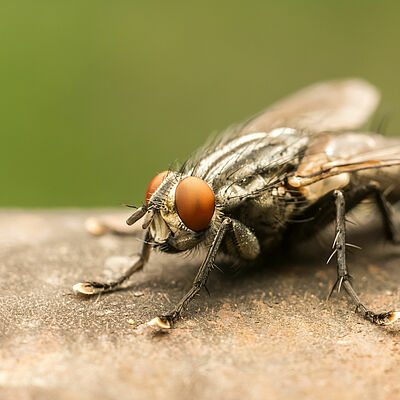
Life cycle and appearance of House fly
The adult house fly (Musca domestica) is 6–7 mm long, yellowish-grey to dark grey in colour, with four narrow black stripes on the thorax, reddish-brown eyes and clear, translucent wings. Female house flies will typically only mate once and retain the sperm for future egg fertilization. When protein-rich food is available, she will lay up to 500 eggs in several batches on decaying organic matter, such as food waste, carrion or feces, over the course of three to four days.
Development time for all Musca domestica life stages is temperature-dependent, with maximum egg production and fly development occurring between 25–30°C. The small (1.2 mm), white eggs will only hatch if they remain moist, and creamy-white larvae (3–9 mm long) with a single pair of dark mouth hooks typically emerge from the eggs within 24 hours. The maggots pass through three larval instars until fully grown (7–12 mm), at which point they crawl to a cool, dry place near the breeding site to pupate.
Flies in the pupal stage are oval-shaped, with bluntly rounded ends, about 8 mm long and change in colour from yellow to red, to brown, to black as the pupa ages. New adult flies will emerge as early as two days after pupation (at temperatures above 30°C) or over three weeks later at low temperatures (around 15°C). Adult flies have an average life span of 15–25 days, but can live up to two months in the right conditions.