Skip to content

What are brown marmorated stink bugs?

Stink bugs belong to the family Pentatomidae (true bugs) and derive their name from the strong odour that they emit from scent glands when disturbed. The brown marmorated stink bug (Halyomorpha halys) is of Asian origin and has in recent years invaded North America and Europe. Halyomorpha halys has over 100 reported host plants. It is widely considered an arboreal species and can frequently be found in woodlots.

The brown marmorated stink bug can inflict severe damage in fruits like for instance apple, pear and peach, vegetable crops like sweet pepper and tomato and also field crops like maize and soybean.

Biological solutions for Brown marmorated stink bug

Filters:
Clear all filters
Show all Show less
products found:

Questions or need help?

Find a reseller
  • Easy to use
  • Minimal resistance
  • No chemical residues
  • No pre-harvest intervals

Learn more about

Brown marmorated stink bug damage

As a polyphagous pest, the brown marmorated stink bug has the potential to cause damage to several crops, including tree fruit, nuts, vegetables and row crops. On tree fruits, feeding injury causes depressed or sunken areas that may become cat-faced as fruit develops. Late season injury causes corky spots on the fruit. Feeding may also cause fruiting structures to abort prematurely. Similar damage occurs in fruiting vegetables such as tomatoes and peppers, although frequently later in the season. Feeding can cause failure of seeds to develop in crops such as maize or soybean. There is frequently a distinct edge effect in crop plots as H. halys has an aggregated dispersion and moves between crops or woodlots.

Life cycle of the brown marmorated stink bug

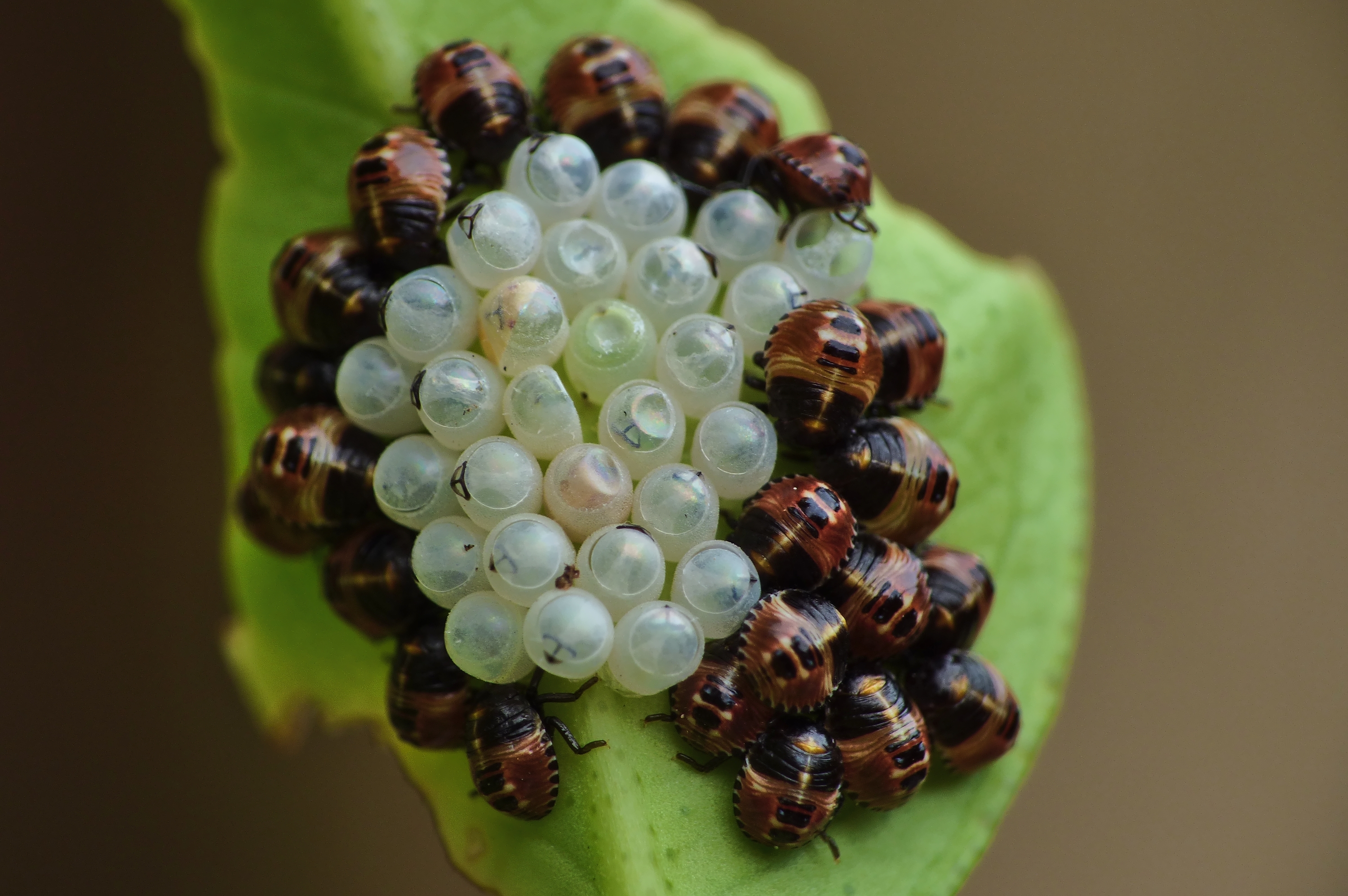
Halyomorpha halys goes through five nymphal instars. Eggs are laid in clusters of approximately 28 on the under surface of leaves. Newly laid eggs are about 1.3 mm in diameter and 1.6 mm in length and light green or light blue. As the embryo develops it may become visible through the egg, with the eyes appearing as two red spots.

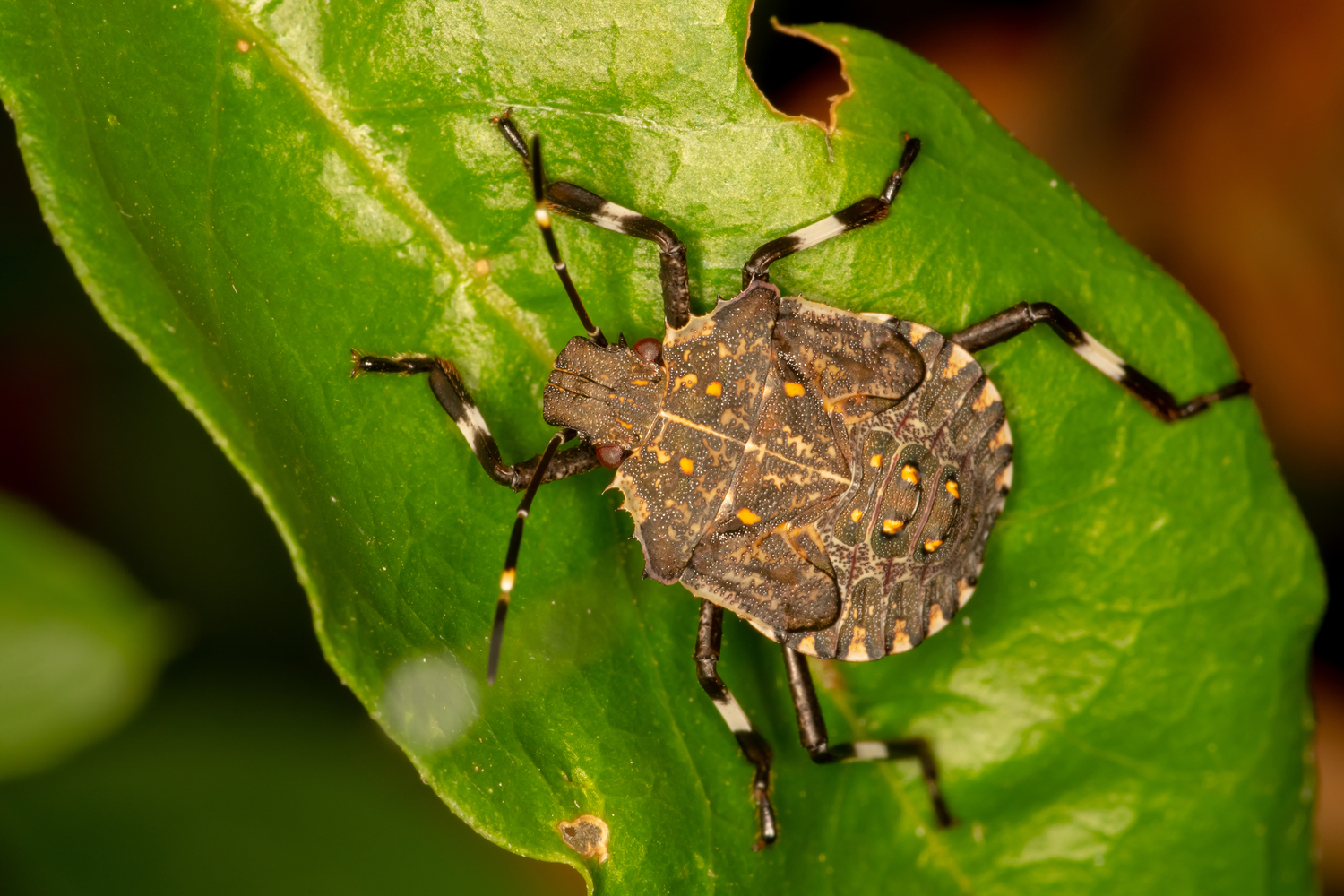
The first instar nymphs are approximately 2.4 mm in length, with a black head and thorax and an orange-red abdomen. First instars, aggregate around the empty eggs. The possible advantages of aggregating in this manner are increased protection from drought and high temperatures, and increased protection from natural enemies by pooling their chemical defences. Following the transition to second instar, the nymphs lose a majority of their orange-red colouring. Second instar nymphs appear dark, with rough spiny projections along the lateral edge of the thorax. Wing buds begin to develop with each successive molt. Later instars have a black to grey base coloration with noticeable spines along the humeral (shoulder) margins, as well as white bands on the legs and antennae.

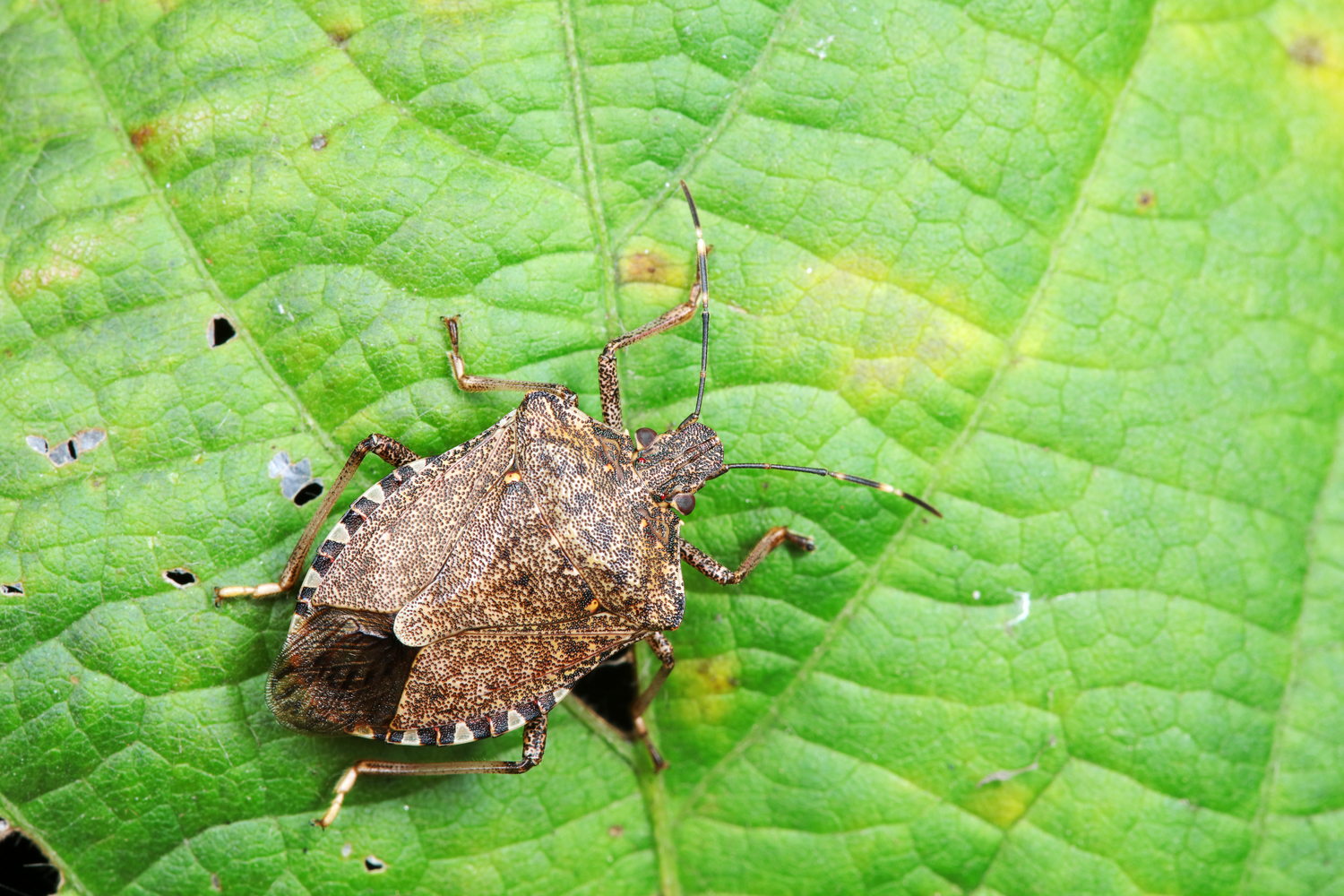
Adults of the brown marmorated stink bug are from 12 to 17 mm in length. The base colour is a mixture of brown, dark red and black on the dorsal surface, with a beige or cream-colored ventral surface punctuated with metallic green markings on the ventral thorax. Key features for identification of the adult include white bands on antennae and legs, no humeral (shoulder) spines, and alternating dark and light bands on the margin of the abdomen.

Recognize brown marmorated stink bugs

Brown marmorated stink bugs can be recognized in a crop through several signs and observations:

Visual detection

Look for the presence of adult brown marmorated stink bugs on plants or surrounding areas. They have a characteristic shield-like shape, mottled brown coloration, and are approximately 1.7 centimeters in length. Keep an eye out for their distinctive triangular pattern when viewed from above.

Damage symptoms

Feeding damage is caused by adults and nymphs of brown marmorated stink bug. On tree fruits, feeding damage results in depressed or sunken patches that could eventually grow into "cat faces" as the fruit matures. Corky patches on the fruit are a result of late-season injury. Fruiting structures may prematurely terminate if they are fed. Although it usually happens later in the season, similar damage also happens to fruiting plants like tomatoes and peppers. In crops like soy or corn, feeding can prevent seeds from growing. As H. halys wanders between crops or woodlots and has an aggregated dispersion, there is frequently a noticeable edge impact in agricultural plots. This can cause soyabeans to have a "stay green" effect, whereby H. halys feeding damage prevents pods from senescing at the edges.

Foul odor

When disturbed or crushed, brown marmorated stink bugs release a strong, pungent odor from their scent glands. If you notice a foul or unpleasant smell in your crop or surrounding areas, it may indicate their presence.

Crop monitoring

Regularly inspect your crop for signs of brown marmorated stink bugs. Use visual observation or shake plants gently to dislodge any hidden stink bugs. Focus on areas where they are likely to congregate, such as the undersides of leaves, fruit clusters, or sheltered areas.

Trapping

Set up pheromone traps or sticky traps specifically designed for capturing stink bugs. These traps can attract and capture adult brown marmorated stink bugs, providing an indication of their presence and population levels.

Need help?