
Skip to content

General

The mottled arum aphid, Neomyzus circumflexus, has a cosmopolitan distribution and a wide host range. In temperate climates it is primarily a pest in greenhouses where it attacks many ornamentals, including chrysanthemums, Begonia and Fuchsia, and also sweet pepper.

Biological solutions for Mottled arum aphid

Filters:
Clear all filters
Show all Show less
products found:

Questions or need help?

Find a reseller
  • Easy to use
  • Minimal resistance
  • No chemical residues
  • No pre-harvest intervals

Learn more about

Damage symptoms

Large colonies of mottled arum aphids can greatly reduce plant vigour and kill the plant through sucking of plant sap. However, also at lower densities the aphids can damage plants because they produce large amounts of honeydew, which provides an excellent substrate for the growth of black sooty mould. Large areas of mould covering the leaves can reduce photosynthesis and also result in an unattractive plant with a much lower market value. Neomyzus circumflexus can also transmit plant viruses.

Life cycle and appearance of Mottled arum aphid

Aphids moult four times before reaching adulthood. With each moult they shed white skin, betraying their presence in the crop.

Reproduction of the mottled arum aphid is entirely by parthenogenesis, with unfertilized viviparous females continuously producing new generations of females. There is no sexual stage in the life cycle.

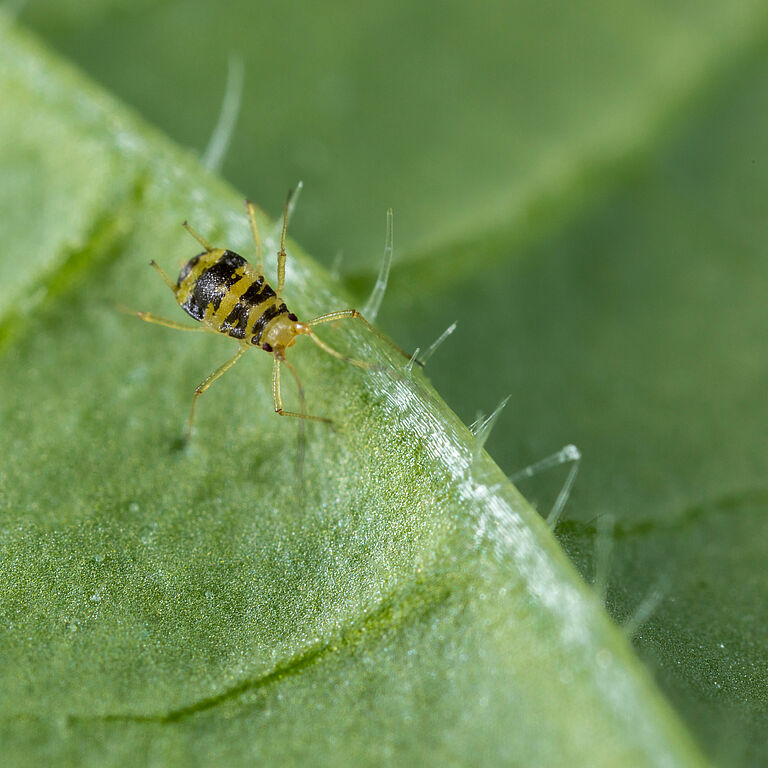
Wingless females of the mottled arum aphid are shiny whitish, yellowish or green with black cross bands behind the head, broken along the midline, and a large horseshoe-shaped spot on the back of the abdomen. These black markings can be highly variable. Adult females are 1.2-2.6 mm long. Immature Neomyzus circumflexus are usually the same background colour as their parents, but they lack the characteristic black markings.

Need help?