Damage symptoms
Blueberry aphids live in dense colonies on young shoots of blueberry bushes and produce large amounts of sticky honeydew. The aphids spread blueberry scorch virus. This virus disease can cause severe yield loss.
The blueberry aphid, Ericaphis fimbriata or Ericaphis scammelli, is most likely of North American origin and was probably introduced into Europe with plant material. It feeds on blueberries and is a vector of blueberry scorch virus.
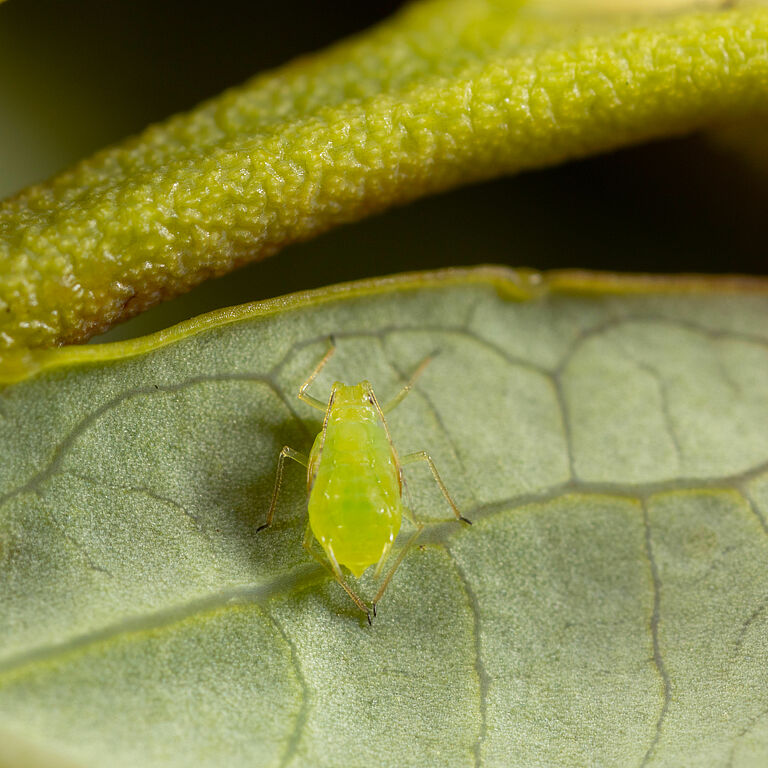

Blueberry aphids live in dense colonies on young shoots of blueberry bushes and produce large amounts of sticky honeydew. The aphids spread blueberry scorch virus. This virus disease can cause severe yield loss.
Aphids have a complex life cycle, with both winged and wingless forms of adults and a great variety in colour. In greenhouses, reproduction takes place by parthenogenesis, with unfertilized viviparous females continuing to produce new generations of females. Aphids moult four times before reaching adulthood. With each moult they shed white skin, betraying their presence in the crop.
Wingless females of the blueberry aphid are pale yellow-green. The siphunculi are long and straight.
Blueberry aphids overwinter as eggs on blueberry bushes. The fundatrices (founding mothers) emerging from the eggs produce wingless and winged parthenogenic females which then continue to produce females. The aphids are mainly found on young shoots. Peak aphid densities are reached in June and July. Sexual adults are produced in September and October and the sexual females lay eggs on blueberry bushes for overwintering.