Damage symptoms
Blackcurrant aphids produce large amounts of sticky honeydew on which black sooty mould fungi grow. Leaves and fruit quickly turn black and fruit can become unmarketable.
The blackcurrant aphid, Cryptomyzus galeopsidis, attacks black currant and also red current. It is widespread throughout Europe and also present in the Russian Far East and North America.
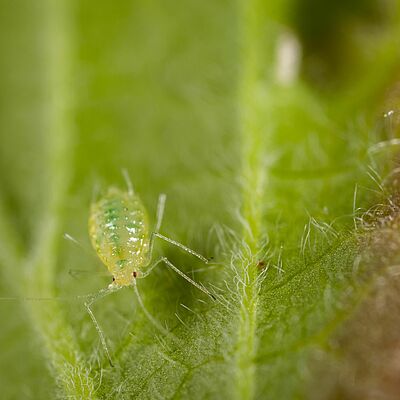

Blackcurrant aphids produce large amounts of sticky honeydew on which black sooty mould fungi grow. Leaves and fruit quickly turn black and fruit can become unmarketable.
Aphids have a complex life cycle, with both winged and wingless forms of adults and a great variety in colour. In greenhouses, reproduction takes place by parthenogenesis, with unfertilized viviparous females continuing to produce new generations of females. Aphids moult four times before reaching adulthood. With each moult they shed white skin, betraying their presence in the crop.
Wingless females of the blackcurrant aphid are 1.3-2.6 mm long and pale greenish white or sometimes yellowish, often with a darker green spinal stripe. The distal third of the siphunculi is slightly swollen.
In spring, the blackcurrant aphid lives on the underside of the young leaves of currant plants. It does not induce a gall on blackcurrant. In June, it migrates to hemp nettle and other Lamiaceae where it curls and rolls the young leaves. Some populations do not migrate from currants.