Damage symptoms
Infection by Ustilago nuda f.sp. tritici remains invisible until head emergence. The first sign of infection is the appearance of a smutted ear. Instead of normal tissue, the ear contains a mass of olive-brown smut spores.

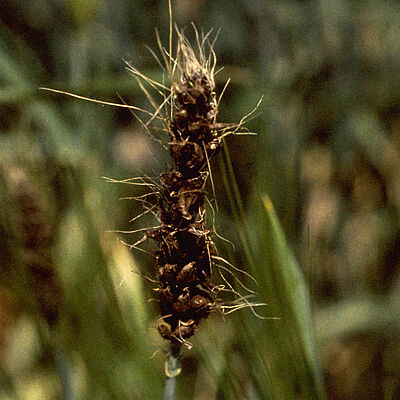
Ustilago nuda f.sp. tritici is a basidiomyceteous fungus that affects wheat. It is also known as loose wheat smut, or loose smut of wheat.

Infection by Ustilago nuda f.sp. tritici remains invisible until head emergence. The first sign of infection is the appearance of a smutted ear. Instead of normal tissue, the ear contains a mass of olive-brown smut spores.
The seeds are infected during flowering and the infected seeds are the primary source of inoculum in the next crop. The fungus survives inside the seed and when the seed germinates, the mycelium of the fungus grows upwards inside the plant into the growing tip and the seed primordia. It only becomes visible after head emergence. The teliospores that are formed on systemically infected seeds then infect neighbouring new seeds. They germinate within a day and infect the inner tissues of the newly infected seed. During maturation of the seed, the mycelium becomes thick-walled and swollen as a dormant survival structure.
Infection mostly occurs before pollination and within one to two days after pollination.
Prevent plant diseases by optimizing plant potential and crop resilience.