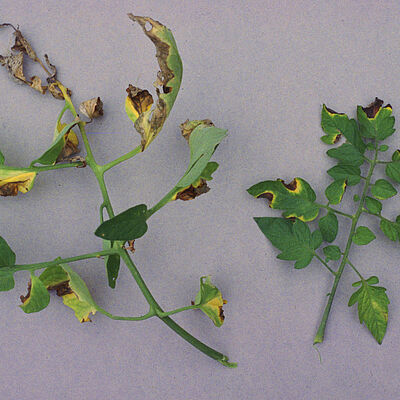
Damage symptoms
Clavibacter causes spots on stems, leaves and fruits. Leaves and shoots wilt. On the lower leaves, blister-like white lesions occur, which later turn brown and may merge. The leaves wilt and curl upwards, often starting at one side of the plant. They turn brown but don’t fall off. On stems and shoots light stripes form, which then tear, allowing cankers to form. On tomato leaves, water-soaked lesions occur, usually white with a brown centre.
In potato, the disease usually only occurs in the second half of the season. The first symptoms are wilting of the lower leaves and subsequent expansion of the wilt upwards. Cutting the stem at the foot shows whitish ooze with bacteria in the case of Clavibacter infection, but other than that the disease is difficult to distinguish from wilting caused by other pathogens.
On potato tubers, first discolouration of the vessel tissue appears, especially when cutting the tubers. This discolouration is round, hence the name ring rot.