Skip to content

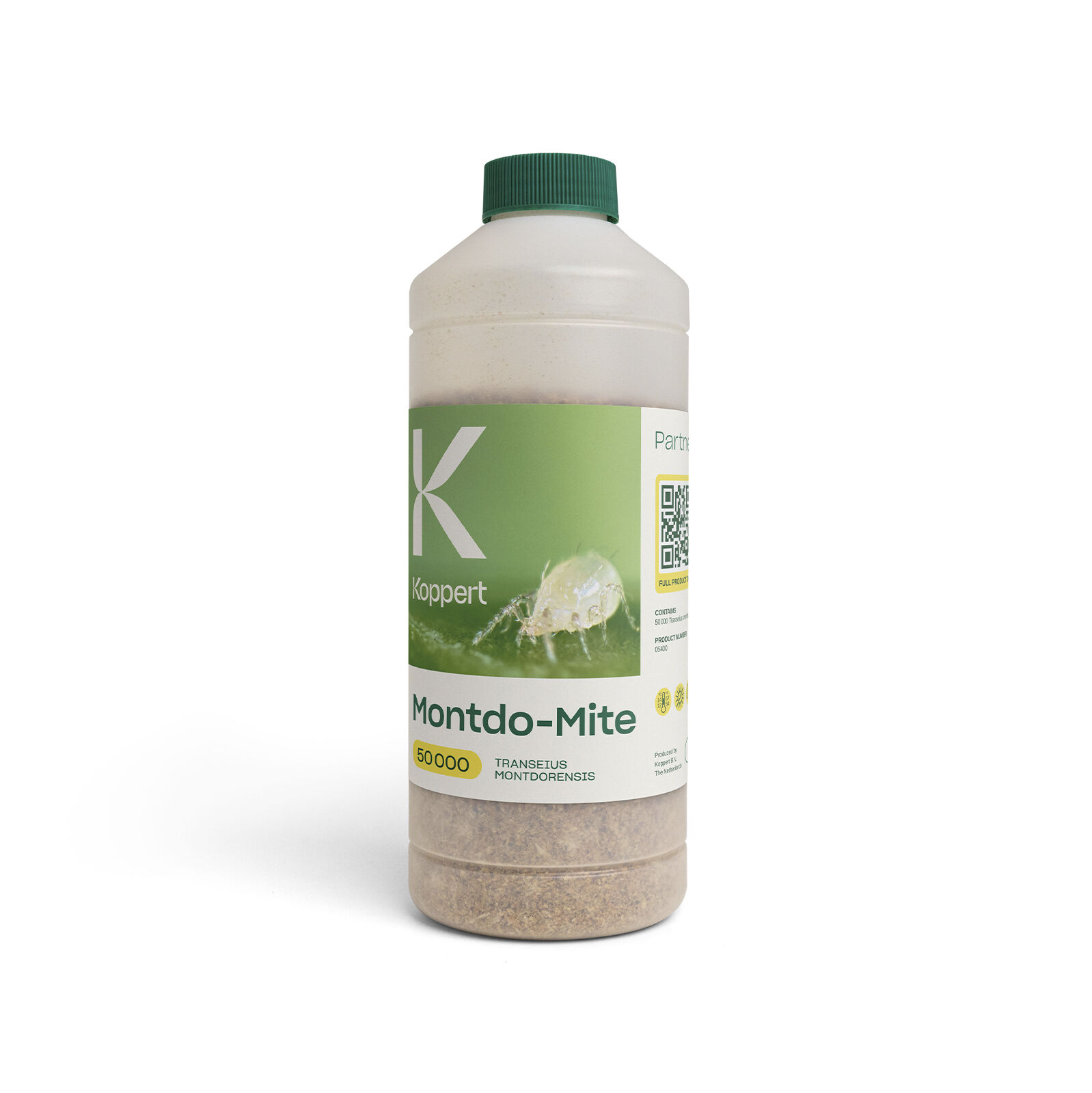
Montdo-Mite

  • Transeius montdorensis
  • Predatory mites
Testimonials
Downloads

Use for:

  • Thrips
  • Whiteflies
  • Generalist predatory mite for the control of thrips and whiteflies

  • Can survive on pollen or other prey

  • Especially for use in chrysanthemum

  • Jump to:
  • Use for
  • Product details
  • Directions for use

Use for

Pests

Young larvae of various thrips species, eggs and larvae of whitefly. Also has an effect on all stages of non-webbing spider mites (e.g. European red mite, Panonychus ulmi) and rust mites.

Crops

  • Builds up high populations in chrysanthemum when used in combination with Nutari
  • Do not use in tomato

"The general conditions of Koppert (Koppert B.V. and/or of its affiliated companies) apply. Only use products that are permitted in your country/state and crop. Always comply with the conditions specified in local product registrations. Koppert cannot be held liable for unauthorized use. Koppert is not liable for any loss of quality if the product is stored for longer than recommended and/or under incorrect conditions."
Product details

Mode of action

Predatory mites pierce their prey with their sucking mouthparts and suck out the contents.

Product specifications

Pack size 50,000; 250,000 predatory mites.
Presentation 1,000 ml bottle; 6 litre bucket
Carrier Bran and sawdust.

Directions for use

Application

Dosage

The dosage of Montdo-Mite depends on climate, crop and pest density and should always be adjusted to the particular situation. Start introduction as soon as the first pests are detected in the crop. Introduction rates typically range from 25-300 per m2/release. Releases should be repeated once or twice, or until control is achieved. Consult a Koppert advisor or a recognized distributor of Koppert products for advice on the best strategy for your situation.

Environmental conditions

Transeius montdorensis is most effective at temperatures between between 20 and 32°C (68 and 90°F). It is not effective at temperatures below 15°C/59°F. Transeius montdorensis is sensitive to relative humidity below 70%.

Combined use

Can be combined with Orius spp. and whitefly parasitoids. Do not mix with other generalist predatory mites (Amblyseius swirskii, Neoseiulus cucumeris, Amblyseius andersoni and Amblydromalus limonicus).

Precautions

Application of this product can cause sensitization or allergic reactions, we therefore advise to take the necessary precautions.

Storage time after receipt

Apply as soon as possible after receipt. If necessary, the product can be stored for 1-2 days.

Storage temperature

12-14°C/ 54-57°F.

Storage conditions

In the dark, provide ventilation to prevent CO2 accumulation.

Need help?