Nesidiocoris tenuis for pest control
Nesidiocoris tenuis, commonly known as the tomato bug, is a valuable natural enemy for biological pest control of Tuta absoluta and whitefly. Nesidiocoris tenuis is a generalist predator, also feeding on aphids, spider mites and larvae of leaf miners. This beneficial insect has been used effectively in integrated pest management (IPM) programs in tomato.
The predatory bug Nesidiocoris tenuis is mostly used for biological pest control of eggs and larvae of:
- Tomato leafminer (Tuta absoluta),
- Greenhouse whitefly (Trialeurodes vaporariorum)
- Tobacco whitefly (Bemisia tabaci)
Nesidiocoris tenuis is available at Koppert as Nesibug. Nesibug is available in limited countries.
How to apply Nesidiocoris tenuis
The predatory bug Nesidiocoris tenuis is available in bottles (Nesibug).
- Sprinkle material on clean, dry rock wool slab, in Diboxes or on leaves. Make sure the material is not disturbed for at least a few hours
- Introduce in clusters of at least 25 predatory bugs
- Create 6-10 distribution points per bottle
- Spread material thinly (maximum 1 cm thick) to enable the predatory bugs to get out of the carrier material
- Use Entofood to provide a nutrient source in the beginning of the season, when in general pest pressure is low. This enhances development of Nesibug
- After a few weeks Artefeed can also be used
Nesidiocoris tenuis products

Best conditions for use of Nesidiocoris tenuis
The optimal temperatures for Nesibug are between 20°C and 30°C.
Feeding behaviour of Nesidiocoris tenuis
Nesidiocoris tenuis feeds on both Trialeurodes vaporariorum and Bemisia tabaci, with a preference for whitefly eggs and larvae, although it consumes all stages. When feeding, Nesidiocoris tenuis sucks out the contents, leaving the empty cuticle intact or slightly collapsed. They do not distinguish between parasitized and non-parasitized whitefly larvae but tend to avoid attacking pupae once they turn black or yellow due to parasitization by Encarsia formosa or Eretmocerus eremicus, respectively.
Nesidiocoris tenuis is a generalist predator, also feeding on aphids, spider mites, moth eggs, small caterpillars, and larvae of leaf miners. It is particularly effective against Tuta absoluta, with adults preying on over 30 eggs per day and a few larvae.
While Nesidiocoris tenuis can survive on plant sap alone when prey is scarce, this diet is insufficient for full population development. Egg-laying continues at a lower rate, and nymphs struggle to develop into adults. Feeding on plant sap can damage tomato plants, especially at high predator densities. This damage can result in a so called ‘necrotic ring’ around young shoots and flowers, causing them to abort. Damage severity is influenced by the ratio of prey to predators and by temperature, increasing with higher predator density and temperature and decreasing with more available prey.
Life cycle of Nesidiocoris tenuis
Growers can recognize the different life stages of the predatory bug Nesidiocoris tenuis, a valuable biocontrol agent against various pests, by noting distinctive characteristics at each stage.
-
Egg stage: Nesidiocoris tenuis eggs are tiny, elongated, and typically whitish or translucent. These eggs are usually laid in older veins, leaf and fruit stalks, and in the main stem. They are difficult to see without a magnifying glass or microscope. Growers should look for tiny puncture marks on plant tissues where the eggs might have been deposited.
-
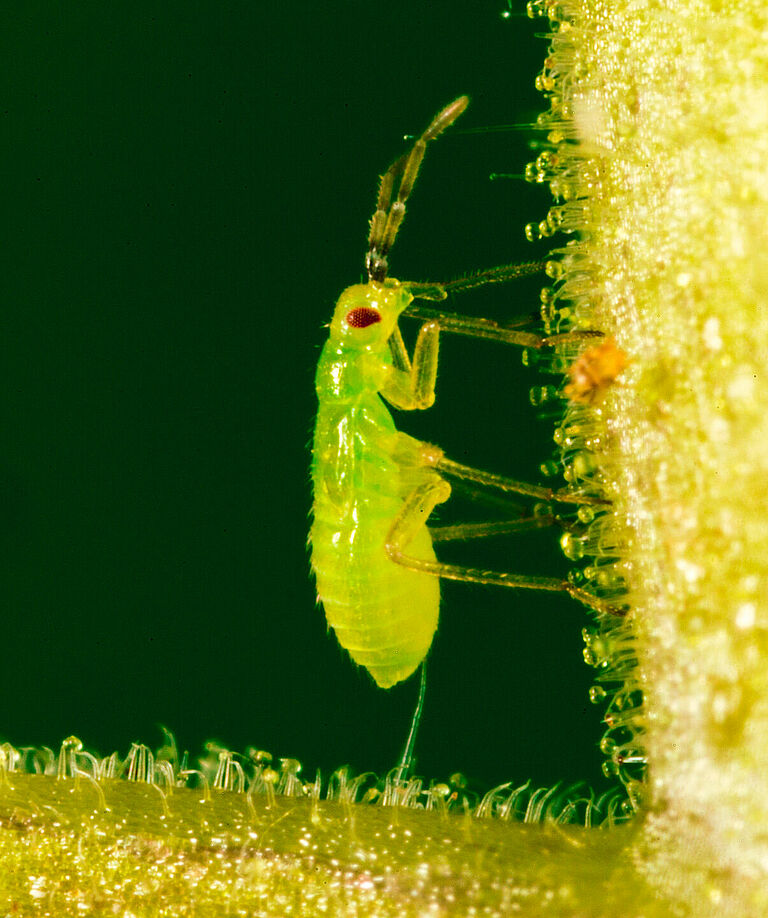
Larval stage: The nymphal stage is when Nesidiocoris tenuis resembles miniature versions of the adults but lacks fully developed wings. Nymphs are usually yellow-green in color. As nymphs mature, they pass through five instar stages, gradually increasing in size and developing more pronounced body segments and wing pads. Nymphs are active and can be seen moving around the plant, often in areas where pests like whiteflies, aphids, or spider mites are present. They feed on these pests by piercing and sucking out their body fluids.
-
Adult stage: In the adult stage, Nesidiocoris tenuis are small, slender bugs, about 3-4 millimeters in length, characterized by their green color and distinct elongated bodies with long antennae. Adults have fully developed wings that lie flat over their bodies when at rest, and their wings are clear with green veins, giving them a somewhat transparent appearance. Adults are highly mobile and can be seen actively hunting for prey on plant surfaces. They feed on a variety of pests, including whiteflies, aphids, and spider mites, and in the absence of prey, they might also feed on plant tissues or pollen.
By regularly inspecting plants and noting the presence of these life stages, growers can effectively monitor the population dynamics of Nesidiocoris tenuis and assess their impact on pest control. Maintaining a favorable environment for these predatory bugs can enhance their efficacy as biocontrol agents in integrated pest management programs.